
Gestalt Language Processing Therapy in Irvine, CA
Speech therapy for children who learn language in whole phrases and scripts rather than one word at a time.
If your child speaks in lines from shows, repeats what you just said, or has a handful of long phrases they use for everything, that is not a mistake to correct. It is a different route into language, and it has a path forward.
What gestalt language processing is
Most children build language from the bottom up. They learn single words, then stick two together, then three, and grammar assembles itself from the pieces. That is analytic language processing, and it is the model almost every speech milestone chart is written around.
Some children work top down instead. They take in a whole chunk of language, a gestalt, and store it intact: a line from a show, a phrase a parent says every morning, an entire song. The chunk carries meaning as a unit. A child might say "to infinity and beyond" to mean something closer to "I am excited," because that phrase was attached to excitement the first time they heard it.
That is gestalt language processing. It is a recognized developmental route, not a disorder in itself, and it is common among autistic children. What these children need is not to be pushed back to single words. They need help breaking those chunks down so the pieces can be recombined into language of their own.
What it looks like at home
Parents usually describe some version of these before anyone uses the word gestalt.
The scripts
- Speaks in lines from shows, books, or videos
- Repeats a phrase you use, in your intonation, sometimes days later
- Repeats what was just said to them, immediately
- Uses one long phrase in situations that seem unrelated
- Sings whole songs but does not use single words
The mismatch
- Rich, adult-sounding phrases alongside very little flexible speech
- Sounds advanced in some moments and stuck in others
- Struggles to answer a simple question despite a large phrase repertoire
- Pronouns come out reversed or fixed inside a phrase
- Grammar seems to appear and disappear
The frustration
- Distress when the script does not fit what they need to say
- Gives up rather than trying a new way to say something
- Has been told to "use your words" without it helping
- Previous therapy focused on single words and stalled
- Understood at home, not understood anywhere else
How the language develops
We use the Natural Language Acquisition framework, which describes the predictable path a gestalt language processor moves along. It is a sequence, not a timetable, and children move through it at very different speeds.
Whole scripts
Your child uses complete chunks exactly as they took them in, intonation and all. The chunk means something specific to them, even when the words look unrelated to the situation. The work here is figuring out what each script actually means to your child.
Mixing and trimming
Scripts start getting shorter, and pieces of different scripts get combined. This looks like a step backwards to a lot of parents. It is the opposite: it is the first evidence that the chunks are coming apart.
Single words appear
Individual words break free of their original chunks and start getting used on their own, then in short original combinations. This is often where families first feel the change.
Original sentences
Your child builds their own sentences, with their own grammar, and the scripts become one tool among many rather than the only one. Grammar continues developing well past this point, as it does for any child.
Why we do not discourage echolalia
For a long time the standard advice was to stop the scripts. We think that advice was wrong, and it cost children something.
- The scripts are communication. They carry meaning, intent, and feeling. Treating them as noise to be extinguished tells a child their attempts to reach you do not count.
- They are the raw material. A child cannot break down chunks they are not allowed to use. Suppressing scripts removes the very thing the next stage is built from.
- Correcting rarely works. Pushing a gestalt processor toward single words tends to produce compliance without communication, and it is a common reason earlier therapy stalled.
- We work out what each one means. The first job is decoding your child's scripts with you, since you have the context nobody else has.
- We give better scripts. Modeling flexible, easy-to-break-down language your child can take in and reuse.
- Neurodiversity-affirming throughout. The goal is a child who can say what they mean, not a child who sounds like everyone else.
How we work with gestalt language processors
Gestalt language processing is one part of our speech therapy. See all pediatric therapy services for the full picture.
Speech and language therapy
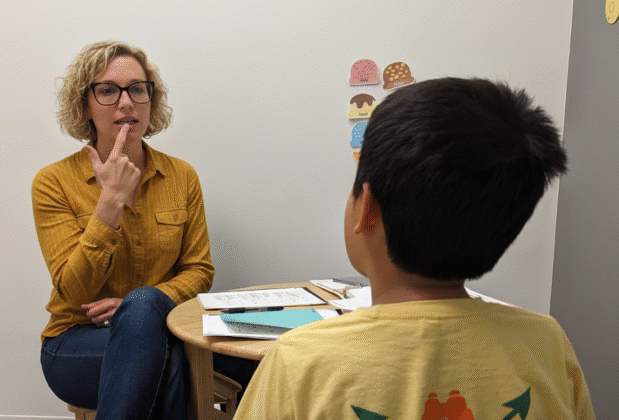
GLP work happens inside speech therapy. Where articulation, social language, or fluency also matter, they are worked on in the same 50-minute sessions.
Speech therapy in Irvine
AAC alongside spoken language
Many gestalt language processors benefit from a device or picture system running in parallel. Using AAC does not slow spoken language down, and it takes pressure off while the scripts are coming apart.
Book a tour to talk it through
Occupational therapy
A dysregulated nervous system makes flexible language harder to reach. Where sensory processing is part of the picture, our OTs work alongside the speech team.
Occupational therapy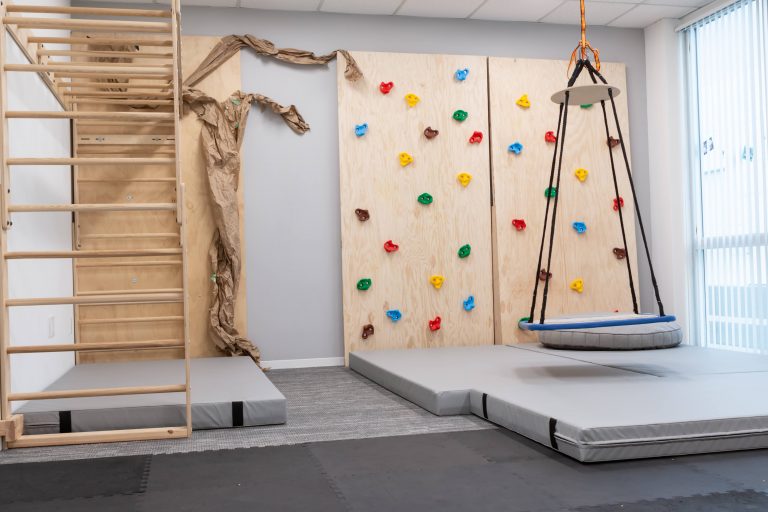
School collaboration and IEPs
Teachers often read scripting as off-task behaviour. We work in partner classrooms across Orange County and attend IEP meetings so the school understands what your child is actually doing.
School collaborationsWho your child would work with
Our speech-language pathologists hold at least a master's degree in speech-language pathology, current state licensure, and the Certificate of Clinical Competence from the American Speech-Language-Hearing Association. They work with gestalt language processors using the Natural Language Acquisition framework, and coordinate with our occupational and feeding therapists when a child's needs cross disciplines.
Caseloads stay deliberately small. Your child sees the same therapist week to week, which matters more than usual here: decoding a child's scripts takes familiarity.
Paying for speech therapy
We are an out-of-network provider and are not contracted with any insurance plan, which means we do not bill your insurance directly.
- You receive a detailed superbill twice a month, on the 1st and the 15th, with every code your insurance needs to consider reimbursement.
- Superbills are always available in your parent portal, so you are never waiting on us for a copy.
- Speech therapy is generally an eligible FSA and HSA expense.
- Many of our families do receive reimbursement. Rates vary by plan, and insurers pay families directly.
Questions parents ask about gestalt language processing
Is gestalt language processing a disorder?
Should I stop my child from repeating lines from shows?
What is the Natural Language Acquisition framework?
My child's speech got shorter and choppier. Are we going backwards?
How is this different from regular speech therapy?
Is gestalt language processing only for autistic children?
How long is a session?
What ages do you work with?
Do you take insurance?
Come see the space
If your child's scripts have been treated as a problem to fix, we would like to show you a different approach. Book a tour with our clinical staff and bring your questions.