
Pediatric Speech Therapy in Irvine, CA
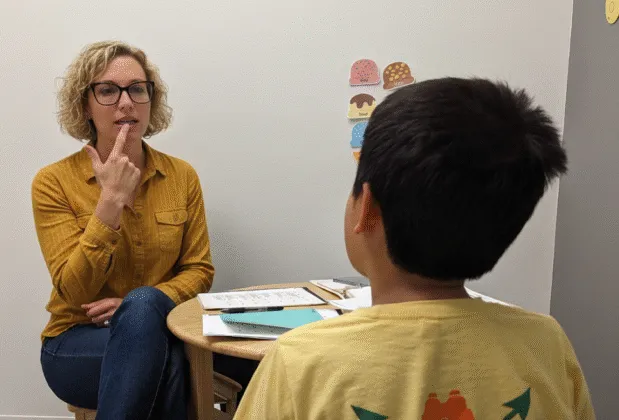
Child-led, play-based speech and language therapy for children up to age 12, from speech-language pathologists who follow your child's interests into communication.
Our SLPs hold master's degrees, state licensure, and the Certificate of Clinical Competence from ASHA. Our approach is neurodiversity-affirming: the goal is being understood and connecting with people, not sounding like everyone else.
Speech and language are two different things
Parents often use the words interchangeably, and the difference matters because it changes what therapy targets.
A speech difficulty is about sound
How the mouth, tongue, and voice actually produce words. A child may know exactly what they want to say and still not be understood, because the sounds are not coming out the way they intend. This covers articulation, phonology, apraxia of speech, fluency and stuttering, and voice or resonance.
A language difficulty is about meaning
Understanding what others say, and putting words together to say what you mean. A child may speak clearly but struggle to follow directions, find the right word, tell you what happened at school, or keep a conversation going. This covers receptive and expressive language, pragmatic and social language, and memory and cognition.
Plenty of children have some of both. That is one reason the evaluation matters: it separates what is actually going on from what it looks like from the outside.
Signs your child may benefit from speech therapy
Any one of these on its own can be typical. It is when several cluster together, or when your child is getting frustrated, that an evaluation is worth having.
How they sound
- People outside the family have trouble understanding them
- Sounds are dropped, swapped, or softened past the age you would expect
- Repeats sounds or words, or gets stuck and blocks
- A hoarse or unusually nasal voice that does not go away
- Knows what they want to say but cannot get the word out
How they use language
- Fewer words than other children the same age
- Short or scripted sentences where you would expect longer ones
- Trouble following directions with more than one step
- Cannot tell you what happened at school in an order that makes sense
- Reaches for a word and lands on the wrong one, or on "that thing"
How they connect
- Repeats whole phrases or lines from shows and books
- Hard to join or stay in play with other children
- Misses the back and forth of a conversation
- Big frustration or meltdowns when not understood
- Coughs, gags, or struggles with textures at meals
What we work on
Every plan is built around one child, but these are the developmental areas our speech-language pathologists most often target.
- Expressive language. Putting words together to say what they mean, from first words through full narratives.
- Receptive language. Understanding what is said to them, following directions, and making sense of questions.
- Articulation and phonology. Producing sounds accurately, and the patterns underneath the errors.
- Apraxia of speech. When the brain has trouble planning and sequencing the movements speech requires.
- Gestalt language processing. For children who learn language in whole phrases and scripts rather than single words.
- Fluency. Stuttering, blocks, and the pressure that builds around them.
- Pragmatic and social language. Starting a conversation, taking turns, repairing a misunderstanding, reading the room.
- AAC. Augmentative and alternative communication, from picture systems to speech-generating devices, for children who need another way in.
- Oral motor skills. The strength, coordination, and awareness the mouth needs for both speech and eating.
- Auditory processing. Making sense of what is heard, particularly in noisy rooms.
- Memory and cognition. Holding onto information long enough to use it.
- Swallowing and food aversion. Where communication and feeding overlap, we work alongside our feeding therapists.
What a session looks like
Fifty minutes of play with a target inside it.
- Your child leads, the therapist steers. We follow what your child is interested in and build the language work into it. Motivation does more than drilling does.
- Neurodiversity-affirming. We are not trying to make an autistic child sound non-autistic. We are trying to get them understood and connected.
- Every form of communication counts. Gestures, devices, scripts, and single words are all real communication, and we build from whatever your child already has.
- You are welcome in the room. Most of the practice happens at home, so seeing what works matters.
- The team talks. If your child also sees our OTs or feeding therapists, they all work under one roof and collaborate together.
- Progress gets checked. Goals at three and six months, an update after every session, regular check-ins with parents, and a formal re-evaluation every six.
Ways we support communication
Speech therapy is one of several services at our clinic. See all pediatric therapy services for the full picture.
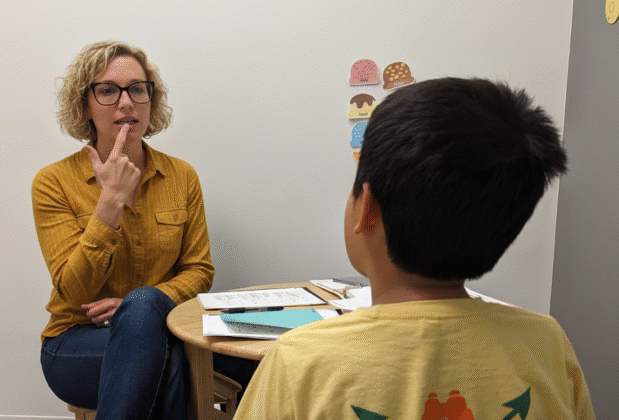
One-on-one speech therapy
Individual 50-minute sessions at our Irvine clinic, targeting the specific areas the evaluation identified. This is where most families start.
Book a tour to get started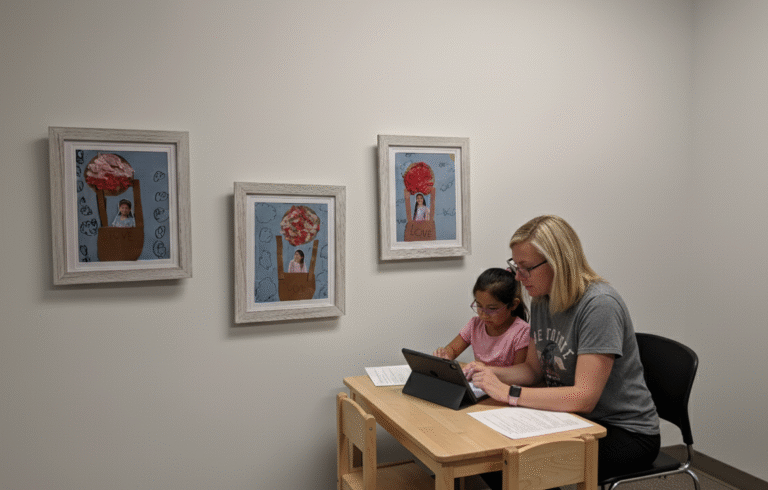
Gestalt language processing
Some children learn language in whole phrases and scripts rather than single words. We use the Natural Language Acquisition framework to move from scripts toward flexible, self-generated language.
Gestalt language processing
Feeding therapy
Where swallowing, oral motor skills, and food aversion are part of the picture, our feeding therapists work in a kitchen and dining area built for it.
Feeding therapy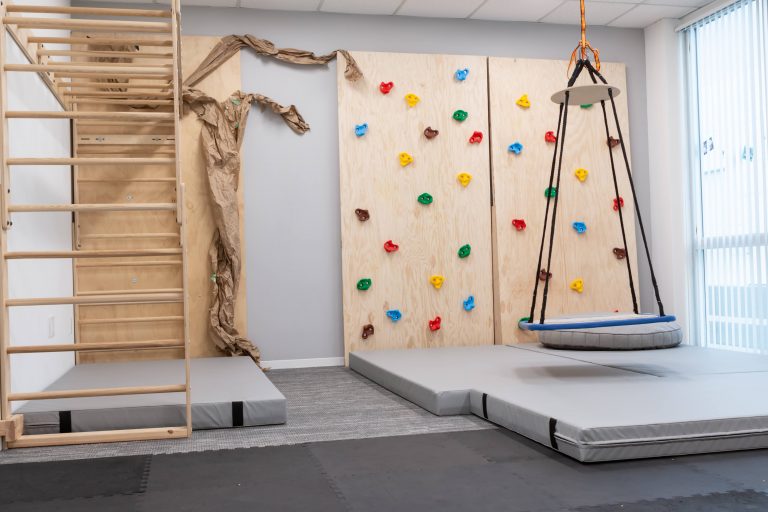
School collaboration and IEPs
We work inside partner classrooms across Orange County, observe children in their own schools, and attend IEP meetings so goals carry into the school day.
School collaborationsWho your child would work with
Our speech-language pathologists hold at least a master's degree in speech-language pathology, current state licensure, and the Certificate of Clinical Competence from the American Speech-Language-Hearing Association. They work with gestalt language processors, with AAC users, and alongside our occupational and feeding therapists when a child's needs cross disciplines.
Caseloads stay deliberately small. Your child sees the same therapist week to week, and that therapist knows your family rather than your file.
Children we work with
We see children up to age 12, with a wide range of diagnoses and, often, no diagnosis at all. A referral is not required to start.
Paying for speech therapy
We are an out-of-network provider and are not contracted with any insurance plan, which means we do not bill your insurance directly.
- You receive a detailed superbill twice a month, on the 1st and the 15th, with every code your insurance needs to consider reimbursement.
- Superbills are always available in your parent portal, so you are never waiting on us for a copy.
- Speech therapy is generally an eligible FSA and HSA expense.
- Many of our families do receive reimbursement. Rates vary by plan, and insurers pay families directly.
Speech and language questions parents ask
What is the difference between a speech disorder and a language disorder?
At what age should I be concerned that my child is not talking?
How long is a speech therapy session?
What ages do you work with?
My child repeats lines from shows and books. Is that a problem?
Do you work with AAC devices?
Do you take insurance?
Do I need a referral or a diagnosis to start?
Can speech therapy happen at my child's school?
Come see the space
The easiest way to know whether we are the right fit for your child is to walk through it. Book a tour with our clinical staff and bring your questions.